
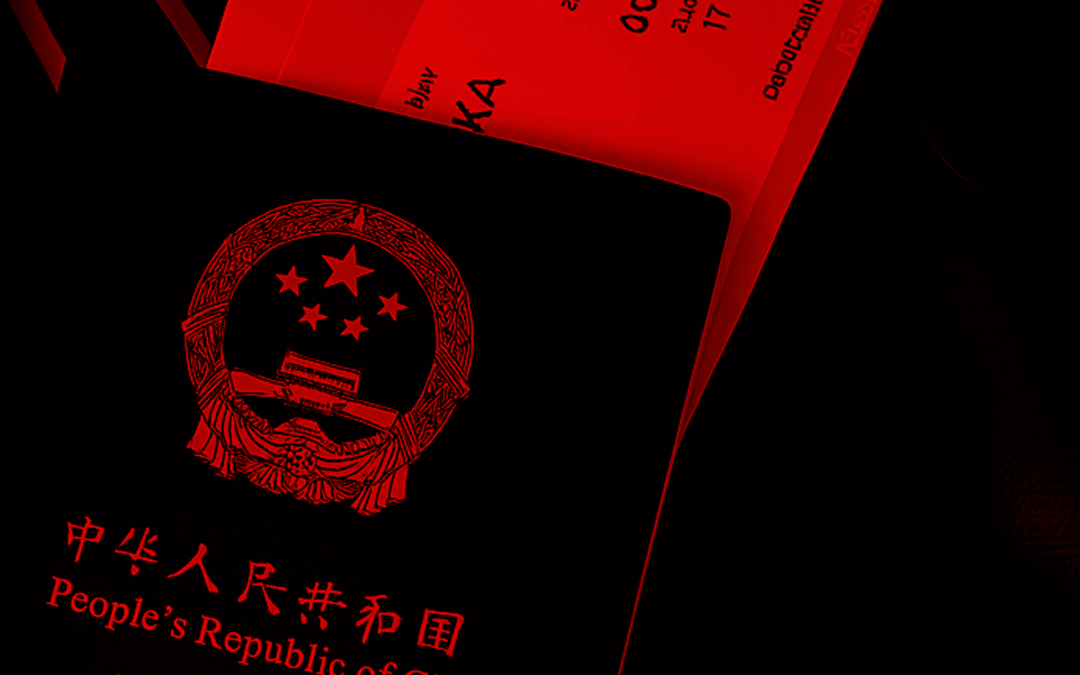
From Tourist to Resident: The 4 Ways for Chinese Citizens to Enter Mexico
Visitor, ABTC, job offer, or family unit. How long do they grant you, how much money do they require, and in what cases can you skip the entire process?
Let's start where no one else starts.
Before you schedule an appointment at the consulate, before you gather three months' worth of bank statements, before you ask your cousin who already lives in Monterrey: there's a real possibility that you won't need to apply for a Mexican visa at all.
It's not a technicality or a rumor from a WeChat group. It's in the rules, and it's based on a document you probably already have in your passport.
We'll explain it to you in a minute. And if it turns out that you do need it, by the end of this text you'll know exactly which of the four categories applies to you, what they'll ask you for, and the order in which everything happens.
First, the question that saves you a trip to the consulate
Do you have a valid and current visa for the United States, Canada, Japan, the United Kingdom, or any country in the Schengen Area?
In that case, you don't need to apply for a Mexican visa.
It must be a physical visa that is valid and current. Not one that expired last year, and not any other type of electronic authorization.
This rule also applies if you can prove permanent residence in Canada, the United States, Japan, the United Kingdom, any country in the Schengen Area, or in the countries of the Pacific Alliance: Chile, Colombia, and Peru.
Mexico now offers an electronic visa, and it’s tempting to assume that it applies to everyone. It does not. This option is reserved for nationalities expressly designated by the Mexican government, and the ordinary Chinese passport is not among them. If you do not qualify for the exemption mentioned above, you must apply in person at the consulate.
Don't fit either of those descriptions? Great—keep reading. Here are the four of them.
1. Visitor without a work permit: the 180-day rule
It's the "I come, I see, I don't get paid here" visa.
It's for tourism, healthcare, travel, and short-term business ventures. You might come to tour a facility, attend a meeting, undergo surgery, or go sightseeing. The only thing you can't do is earn income from a Mexican source.
Duration: up to 180 consecutive calendar days.
If you don't have the exemption, they'll ask you to prove your financial solvency to the consulate in one of two ways.
| Via | What Is Reviewed | Period |
|---|---|---|
| Employment or Pension | Monthly taxable income greater than the equivalent of 220 days of the UMA, plus one year of service | Last 3 months |
| Investments or bank accounts | Average monthly balance equivalent to 680 days of UMA | Last 3 months |
UMA stands for the Measurement and Update Unit. We’ll explain below why that term is the one that changed everything this year.
2. The ABTC Card: For frequent travelers who hate waiting in line
If you are a senior executive, investor, or businessperson from mainland China or Hong Kong, there is a route that rarely comes up in searches: the APEC Business Travel Card.
It is not processed in Mexico. You apply for it through the immigration or commercial authority in your own country. Your information is sent to Mexico for security pre-approval, and once it is authorized, the physical card is issued with the letters "MEX" printed on the back.
What you get:
- Entry into Mexico without a consular business visa.
- Priority lanes at security checkpoints at the country's international airports.
- Up to 180 calendar days per hospitalization, documented as a visitor without permission to engage in paid activities.
The ABTC is valid for up to 5 years, but it is tied to your passport. If your passport expires first, the card automatically becomes invalid. Renewing your passport and forgetting about the card is the most costly mistake you can make in this category.
3. Temporary residency based on a job offer: the one that doesn't start with you
Here is the most common misunderstanding in this entire guide.
Many people arrive at the consulate in Beijing with their contract in hand and leave empty-handed. That's because this process doesn't start at the consulate. It starts in Mexico, and you're not the one who starts it.
Step 1 — In Mexico, before the INM. The Mexican company hiring you files the application as the petitioner and requests a Visa Authorization Based on a Job Offer. To do so, it must have a valid and up-to-date Employer Registration Certificate from the INM. If the company does not have this certificate, the application will not be processed.
Step 2 — at the consulate. Once the INM authorizes the relationship, it issues an official letter valid for 30 business days. Using that letter, you schedule your appointment and appear in person for the consular interview in Beijing, Shanghai, or Guangzhou.
Step 3 — Once in Mexico. Upon entry, you have 30 calendar days—which cannot be extended —to report to the INM and exchange your visa for your physical Temporary Resident Card.
Residency is granted for periods of 1 to 4 years, depending on the duration of the job offer.
Two different timeframes, both short. This is the point where the most applications are rejected due to timing, not because they fail to meet the requirements.
4. Temporary residency for families: the one that brings your loved ones here
If you are already a temporary or permanent resident in Mexico, you have the legal right to apply to bring your family to the country.
Who you can sponsor:
- Spouse, common-law wife, or common-law husband.
- Unmarried children under the age of 18, or adults under guardianship due to legal incapacity.
- Parents.
What you must prove: Financial capacity for each dependent, in one of two ways:
| Via | What Is Reviewed | Period |
|---|---|---|
| Investments or bank accounts | Average monthly balance equivalent to 220 days of UMA | Last 12 months |
| Monthly income (from employment or a pension) | Elderly individuals receiving the equivalent of 220 days of UMA | Last 6 months |
Take a look at the time frames: 12 months for bank transfers, 6 for deposits. They are not the same payment history, and they are not interchangeable.
Four things that don't work the same way they did last year
If someone gave you a guide from two years ago, these four points are no longer accurate.
1. The minimum wage is no longer used. Now everything is calculated in UMA. All references to the minimum wage for proving financial solvency have been officially replaced by the Unit of Measurement and Update (UMA). In practice: your bank statements are evaluated based on the current UMA value as of the date of the application, not based on last year’s value or a reference salary. A calculation based on the wrong figure will result in your application being rejected.
2. You no longer need to bring copies or photos to the consulate. As part of the modernization of Mexican consulates in China, the requirement to submit physical copies and photographs has been eliminated. The consulate creates a digital file and collects your biometric data at the time of the interview: facial image, iris scan, and fingerprints.
3. Your Chinese documents require two steps, not just one. Birth certificates, marriage certificates, and certificates of no criminal record: any public document issued in China must be apostilled or legalized at the source and also translated into Spanish by a certified translator authorized in Mexico. A translation done in China, no matter how good it may be, does not meet the second requirement.
4. Moving without giving notice comes at a cost. All temporary and permanent residents are required to notify the INM of any change in address, marital status, nationality, or place of employment within 90 calendar days. Failure to provide this notice results in an administrative fine in accordance with Article 158 of the Immigration Law.
It is, by far, the easiest one to avoid and the one that most people overlook.
Before scheduling your appointment, check this out
ο Do you have a valid visa for the U.S., Canada, Japan, the United Kingdom, or the Schengen Area? If so, you may not need to go through the application process.
ο Does your passport expire after your ABTC card? If not, the card is no longer valid.
ο If it is for employment: Does the company have a valid Employer Registration Certificate from the INM?
ο Did you calculate solvency using today's UMA value, not last year's?
ο Have your Chinese documents beenapostilled and translatedby a certified translator in Mexico?
ο Have you counted the 30 business days specified in the INM notice and the 30 calendar days for the exchange?
In summary
| If you… | Your category |
|---|---|
| You're visiting, traveling for health reasons, or attending a meeting—without being charged in Mexico | Visitor not authorized to engage in paid activities |
| You travel frequently for business and want priority screening | ABTC Card |
| You've already received an offer from a Mexican company | Temporary Residence Based on a Job Offer |
| You already live here and want to bring your family | Temporary Residence for Families |
One last thing
What determines the outcome of an immigration proceeding is almost never the major requirement. It’s the financial proof calculated using the wrong basis, the translation that wasn’t done by a certified translator, or the official document that expired while you were waiting for your appointment.
At MOXIGE LUSHI (Mexican Lawyers, literally “lawyers from Mexico”), we specialize in corporate and family immigration law between China and Mexico: reviewing source documentation, preparing job offers and employer verification letters, helping clients prepare for consular interviews in Beijing, Shanghai, or Guangzhou, and assisting with the application process at the INM.
Is your situation different? Write to us, and we'll go over it with you.
This article provides general information about immigration categories and is not a substitute for advice regarding a specific case. The amounts expressed in UMA are updated: check the current value as of the date of your application.